

Finding Your Inner Compass
Navigating Life’s Changing Currents
The Current of Summer
When we're lucky, navigating life can feel like floating down a lazy river.
Other times, all we can do is hold steady and hope the storm passes. Sometimes we seek shelter. Sometimes we course-correct. Sometimes we have to rebuild the boat before we can continue.
Summer has a way of holding all of these possibilities at once.
It invites abundance, adventure, and long evenings outdoors.
Yet it can also leave us feeling overstimulated, overextended, and pulled in too many directions. We long for flow—but flow isn't always gentle.
Sometimes navigating well means knowing when to surrender.
Sometimes it means taking the helm.
Listening to the current
So which do we choose?
Surrendering to the extremes as best we can is sometimes all we can do. But using that as a long-term strategy is likely to leave us feeling unmoored, powerless or awash in chaos.
Though overcorrecting towards too much personal control on a long-term basis can cause equal discomfort for ourselves and those in our circle if we continually resist, force, dismiss, or remain tone-deaf to the rhythms inside and around us.
Of course the balance will never be perfect.
We may oscillate toward too much surrender or too much control depending on who we are and our circumstances.
The point is simply to become aware of our tendency. And if our experience feels frequently off kilter — it may be time to begin exploring why.
Finding your compass
When you explore with sound you’re using flow to work with flow.
Sound IS flow.
It reminds us that things are ever changing — and yet, there can still be harmony, balance and direction.
Sound waves push and pull against one another and — over time — organize themselves and the energies around them into coherent patterns.
Researchers continue to explore how and why sound influences our wellbeing. While findings vary, one consistent thread keeps emerging. That intention — when paired with sound — plays an important role in shaping our experience.
Charting your course
What is intention?
Many confuse setting intentions with setting goals — but they’re not the same.
When you’re setting goals, you might ask yourself: “What things can I do to make myself more ‘well’?”
When you set an intention, you might ask:
“What does a ‘well' me even feel like?”
And more importantly - WHY?
With intention, you’re charting the course for your long-game. You learn how to set and recalibrate your inner compass for how you want to steer through your moments — how you hope to move through the world. Intention helps you discern the underlying current of what matters most to you so you can navigate a course that is actually yours and not someone else’s. And, if you happen to lose your way, intention can help you get back on course.
Goals on the other hand, tend to deal with the short-game, relatively speaking. They’re the measurable projects we tackle often to either fix something, optimize something, or get us something we want. They tend to be time-bound and usually we can tell if we hit or missed the mark.
Goals are important. Set along with intention, they can be vital tools and signposts along our larger journey. But — without the deeper orientation of intention, goals can leave us feeling more off-course…
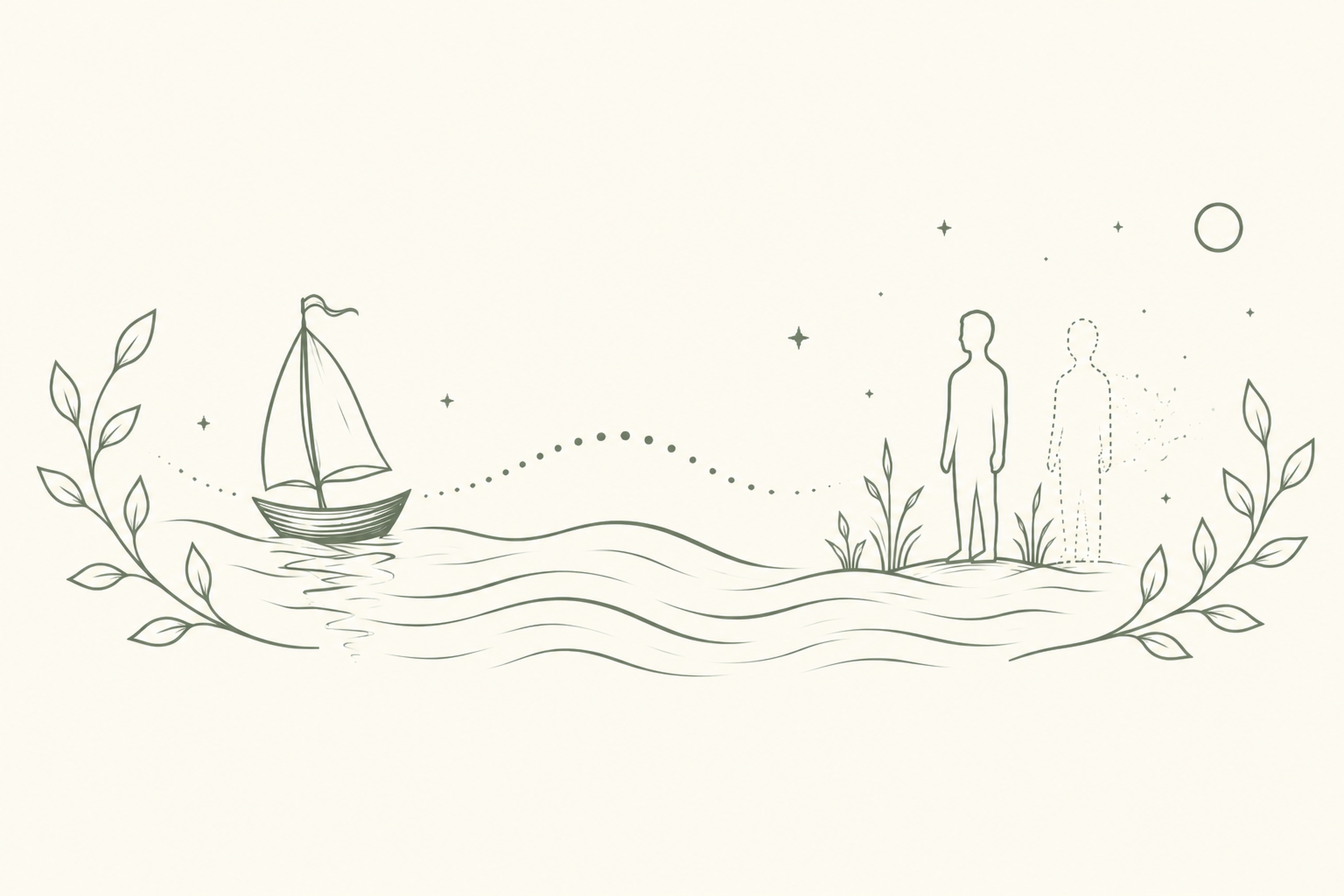
We may become so busy creating self-improvement projects that we leave some or all of ourselves behind…
Believing the person we're searching for exists somewhere "out there," waiting to be achieved.
Learning to trust the compass
Intention gently offers a different possibility.
It doesn’t ask you to be something else in order to discover who you “really” are.
It invites you to become more deeply acquainted with the person who has been there all along.
Intention helps you become familiar with the deeper current that has always been moving beneath your life. As you do, the coherence begins to reveal itself. Gradually, things that once felt disconnected begin making sense together.
As this awareness builds, so does self-trust. Self-trust doesn't mean always knowing the answer. It means learning to recognize the quiet feeling of alignment when your actions begin reflecting what matters most to you. That self-trust becomes your compass.
Returning
There are no perfect answers waiting to be discovered. There is only the practice of listening.
Over time, that listening becomes familiarity.
Familiarity becomes trust.
And trust makes it a little easier to recognize your own inner compass. Especially when life begins pulling you in different directions.
Sound offers a unique way of exploring intention because it gently quiets the constant activity of the thinking mind. As attention softens, many people find it easier to listen to what has been beneath the surface all along—a deeper sense of clarity, wisdom, and inner rhythm.
If you’re able to come see me, of course I would be honored to help you explore the flow of your innate rhythms and how intention can help harmonize them.
But — if you’re practicing on your own — I still invite you to nurture your equilibrium and direction through sound and intention.
I’ve created the playlist “Come Home to Yourself” for exactly this kind of exploration. I recommend having a journal, a piece of paper, or some other form of note taking nearby.
As you listen…
Rather than starting with goal setting about things you need to do or achieve to feel more secure or well — I encourage you to begin with shifting your perspective. Gently guide your awareness away from the business “out there” and bring it back to the feelings “in here.”
Hold the intention to simply befriend yourself.
To understand what wellness feels like to you. You may even say to yourself: “I am centered and aligned in the flow of well-being.”
This intention statement may be enough to center and relax you. But, if you need a bit more direction, keep some of these questions in the back of your mind:
How would I describe the feelings I have when I’m most well?
What kinds of things, people or places inspire this feeling state within me?
What am I continually curious about?
What do I most need at this moment to feel well (well in body, in heart, in mind)?
How do I harmonize and navigate my collective flow with courage, buoyancy, balance and ease?
When you feel centered in this exploration, allow the sounds to carry you. You may experience different images, words, memories, ideas or sensations drift through you in relation to your exploration. These do not need to make sense, or create any kind of linear narrative. Simply let them come, drift away, deepen or evolve on their own.
When your practice comes to a close, remain in silence for a few moments before returning to your day. Notice what lingers. Perhaps it's an image. Perhaps a feeling. Perhaps only a little more spaciousness than when you began.
Whatever you discover, receive it with curiosity. This is about learning to listen. The answers, if they come, often arrive quietly.
If you'd ever like to share what arose during your practice, I'd love to hear from you.